Dental Implant
A titanium screw placed in the jawbone to replace a lost tooth, with a crown built on top of it.
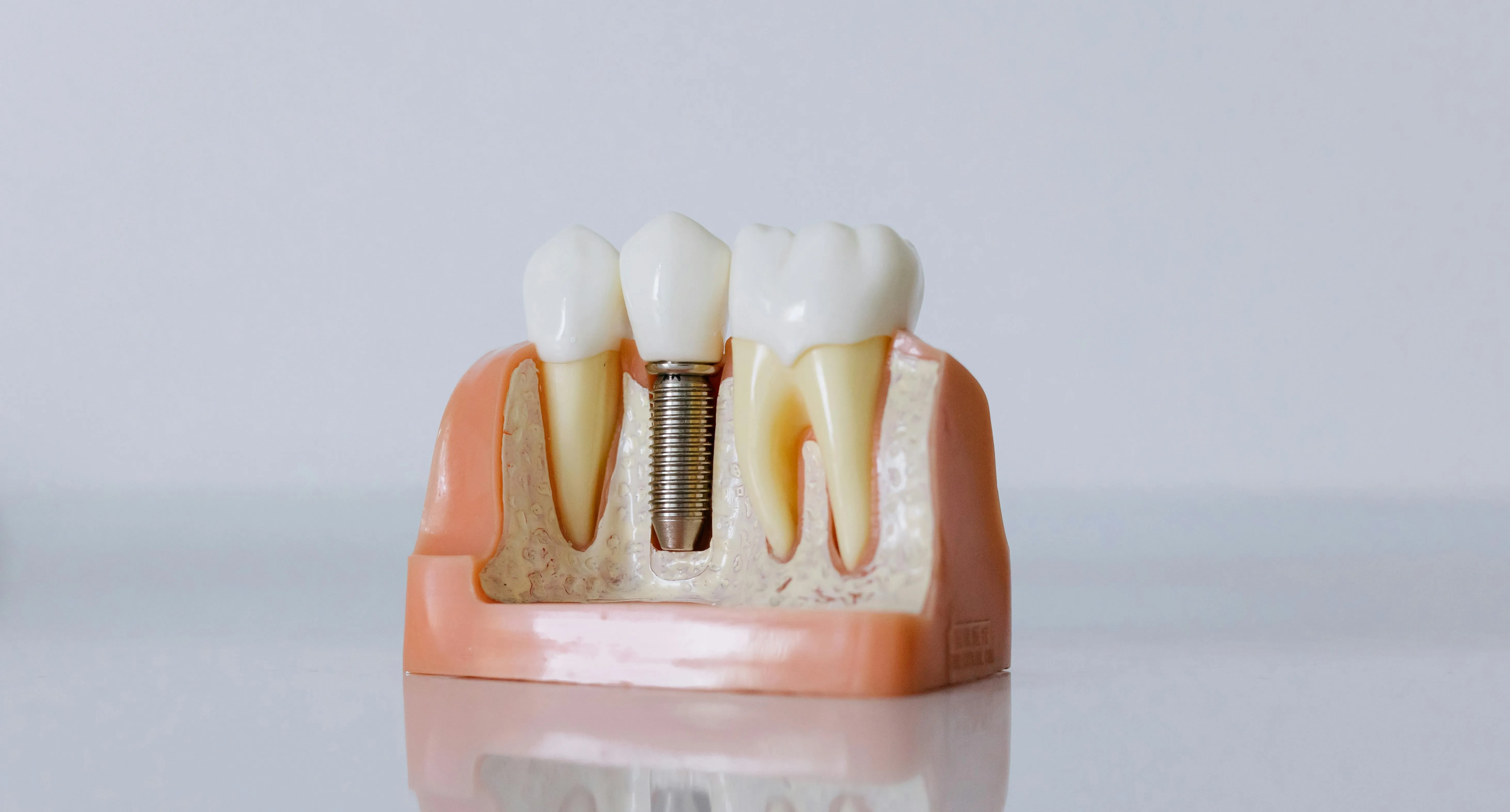
An implant is a titanium screw that takes the place of the root of a lost tooth. It is placed in the jawbone, left to fuse with the bone, and only then is the visible part — the tooth itself — built on top of it.
Why an implant rather than a bridge
With a conventional bridge, the healthy teeth on either side of the gap are ground down and used as abutments. An implant leaves the neighbouring teeth untouched.
The second difference is invisible but more important: once a tooth is extracted, the jawbone beneath it is no longer loaded and resorbs over time. Because an implant transmits load to the bone, it slows that resorption.
Who it is suitable for
The jawbone must have enough density and volume to carry the implant. Where it does not, a bone graft may be placed first — this extends the process by several months.
Uncontrolled diabetes, heavy smoking and certain bone medications make healing more difficult. None of these is an absolute barrier, but they change the plan; they are things to discuss at the first examination.
How it progresses
- Examination and tomography. Bone volume is measured and the position of the implant is planned.
- Placement. Under local anaesthesia, usually 30–60 minutes.
- Healing. Fusion with the bone takes about 3 months in the lower jaw and 4–6 months in the upper jaw.
- Restoration. An impression is taken, the crown is made and attached to the implant.
The gap does not stay visible during this period; a temporary tooth can be made.
Afterwards
An implant cannot decay, but the gum around it can become diseased. Its care is no different from that of a natural tooth: brushing twice a day, cleaning between the teeth, and regular check-ups. A neglected implant can be lost just as a neglected tooth can.